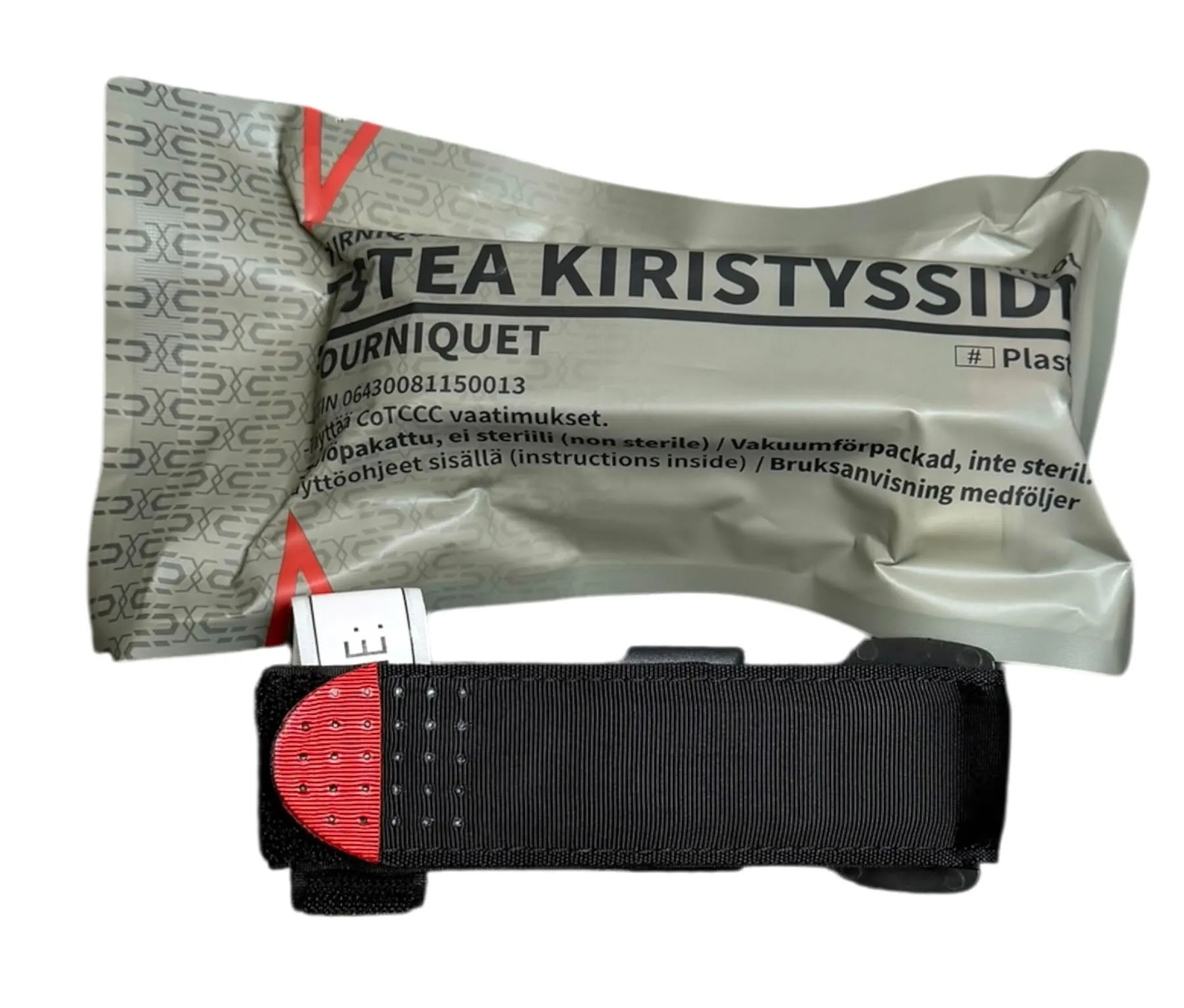
Tourniquet - Complete Guide: Uses and Time Limits
Every year, people in Finland die from bleeding that could have been stopped. A properly applied tourniquet can reduce mortality in life-threatening limb hemorrhages by up to six times.
This comprehensive expert article answers the most important questions about the physiological function of a tourniquet, Finnish official guidelines, the most common mistakes, and the market-leading CoTCCC-approved models.
Q: What is a tourniquet and what is its effectiveness based on?
A: A tourniquet is an emergency medical device that is placed around a limb (arm or leg) to completely block blood flow below the injury. The word comes from the French word tourner (to turn), which refers to the lever mechanism, or tourniquet, used to tighten the bandage.
The tourniquet experienced a medical renaissance during the conflicts in Iraq and Afghanistan (since 2001), where studies showed an 87% survival rate for patients who applied the tourniquet before shock developed. Since the 2013 Boston Marathon bombings, civilian use of the device has rapidly expanded as part of global emergency first aid.
Q: How does a tourniquet work physiologically?
A: A tourniquet provides hemostasis (stopping bleeding) by applying uniform circumferential pressure to the limb.
It is critical to understand the difference between venous and arterial thrombosis:
Venous thrombosis occurs at low pressure. A bandage that is too loose only prevents venous blood from returning to the heart, but allows arterial blood to pump into the limb. This causes paradoxical bleeding – that is, bleeding from the wound actually accelerates.
Arterial occlusion requires high pressure. Only when the tourniquet exceeds systolic blood pressure and tissue pressure does blood flow cease completely. High-quality tourniquets produce 200–500+ mmHg of pressure. Wider straps require less pressure to achieve arterial occlusion, which is why the international CoTCCC standard requires a strap width of at least 38 mm.
Important: A loose tourniquet is more dangerous than no tourniquet at all. The tourniquet should be painfully tight, and the pulse should not be felt below the limb.
Q: When should a tourniquet be used according to Finnish treatment guidelines?
A: In Finland, Duodecim's Basic Care Recommendations (First Aid Guide) and the guidelines for the emergency departments of university hospitals state that a tourniquet is used when there is life-threatening, gushing bleeding in a limb or a massive injury (such as amputation) where a regular pressure bandage is not sufficient or there is no time to apply it.
The international Stop the Bleed model, which is also taught in Finland, guides civilians in three phases:
1. Act quickly – Call the emergency services (112).
2. Locate the leak and apply pressure – Press directly on the wound firmly with straight arms.
3. Apply a tourniquet – If bleeding continues in the limb, apply a tourniquet immediately.
Q: How do I apply a tourniquet correctly? (Step-by-step instructions)
A: These guidelines follow the official TCCC recommendations (January 2024):
1. Placement: Place the bandage 5–10 cm above the wound (closer to the heart). Never place the bandage over a joint (knee or elbow). If the exact location of the bleeding cannot be seen (e.g. in the dark or through thick clothing), place the bandage as high up on the limb as possible (armpit or groin).
2. Initial tightening: Pull the strap through the buckle and tighten it firmly against your skin so that you can't fit your fingers under it before twisting the bar. Attach the Velcro.
3. Rotation: Rotate the tourniquet until all bleeding stops and the distal pulse disappears. Note: This will feel very painful to the patient, which is normal and necessary.
4. Locking and time: Attach the rod to the slot and write the installation time (hours and minutes) clearly on the bandage or on the patient's skin.
You can find the source of the article here.